By QuoteIron TeamUpdated 9 min read
Key takeaways
- At the $95/hour sample rate a mow, trim and blow visit is $55 up to 1/4 acre, $80 for 1/4 to 1/2 acre, $105 for 1/2 to 3/4 acre and $150 for 3/4 to 1 acre. At $75/hour the lots are $45, $65, $85 and $120; at $125/hour, $70, $100, $135 and $195.
- An overgrown first cut up to 1/4 acre is its own line: $150 at $95/hour against $55 for a routine cut. The small-job minimum is $75 per trip.
- Weekly service is four visits a month and bi-weekly is two: a 1/4 to 1/2 acre lot at $80 a visit is $320 a month weekly or $160 bi-weekly.
- Divide each price by its hours as a check: the book’s mowing lines work out to $100 to $110 an hour at the $95 rate. BLS lists a $18.82 median hourly wage for landscaping and groundskeeping workers, which is a wage, not a billing rate.
- Good, Better, Best for a 1/4 to 1/2 acre lot: mow only $80, plus edging $135, plus an hour of bed weeding $235.
Related: Lawn care pricing chart for contractors · How much should an electrician charge per hour · How much should a handyman charge per hour · lawn and landscaping price book · QuoteIron help
If you cut grass for a living, the question is not what the going rate is, it is what your visit costs you to deliver. The numbers here come from QuoteIron’s own price book (priced September 2026). The book stores structure — typical on-site hours and a small supplies cost for string, bags and blades — and your hourly rate does the pricing: hours × your rate, plus supplies at cost with 30% on top, rounded up to the next $5. The three rates used below, $75, $95 and $125 an hour, are the book’s sample rates; $95 is the sample default. Swap in your own before you quote anyone.
Mow, trim and blow: price by lot size
Four lines in the Mowing & Recurring Service category cover a standard visit: cut, string-trim the edges and blow the clippings off the walks and drive. Same formula at three rates:
| Lot size | Hours / supplies | At $75/hr | At $95/hr | At $125/hr |
|---|---|---|---|---|
| Up to 1/4 acre (lc-001) | 0.5h / $2 | $45 | $55 | $70 |
| 1/4 to 1/2 acre (lc-002) | 0.75h / $3 | $65 | $80 | $100 |
| 1/2 to 3/4 acre (lc-003) | 1h / $4 | $85 | $105 | $135 |
| 3/4 to 1 acre (lc-004) | 1.5h / $5 | $120 | $150 | $195 |
Each step up in lot size adds time and a little more supplies, so the price climbs faster than the acreage band suggests: the 3/4 to 1 acre visit is 1.5 hours against 0.5 hours for the smallest lot, and at $95/hour it prices at $150 against $55. If you run a zero-turn on the bigger lots and a walk-behind on the small ones, your real hours will differ from the book’s typical hours. Time a few of your own visits and change the hours, not the rate.
What moves the price
The lot size is only the starting point. These are the separate lines in the book that account for the rest of a mowing price, at the same three sample rates:
| Line | Hours / supplies | At $75/hr | At $95/hr | At $125/hr |
|---|---|---|---|---|
| Push-mow small gated lot, up to 1/8 acre (lc-005) | 0.5h / $2 | $45 | $55 | $70 |
| Edging along walks and drive, per visit (lc-008) | 0.5h / $2 | $45 | $55 | $70 |
| Overgrown first cut, up to 1/4 acre (lc-010) | 1.5h / $3 | $120 | $150 | $195 |
| Bed weeding and cleanout, per hour (lc-016) | 1h / $2 | $80 | $100 | $130 |
| Small-job minimum, per trip (lc-061) | 0.75h / $0 | $60 | $75 | $95 |
- Overgrown first cut. A badly overgrown lawn up to 1/4 acre is its own line: 1.5 hours instead of 0.5, described in the book as slow going with a double cut as needed. At $95/hour it is $150 against $55 for a routine cut of the same lot. Quote the first cut as a one-time visit, then drop to the routine price once the lawn is under control.
- Gates and push-mowing. A small gated backyard up to 1/8 acre that has to be push-mowed is 0.5 hours, $55 at $95/hour. It looks cheap, but a gate you cannot get a ride-on through is the job where small lots earn their money or lose it.
- Edging. A clean edge along walks, driveway and curb line is a separate half-hour line, $55 at $95/hour. Selling it as an add-on keeps the base visit price low and the upgrade visible.
- Route density. The book prices on-site work. Drive time between stops is yours to account for: ten lawns on one street and ten lawns across the county are different jobs at the same lot size. Decide how many minutes of drive your hourly rate has to carry.
- The trip minimum. The book has a small-job minimum per trip: 0.75 hours and no supplies, $75 at $95/hour, credited toward the work if the job goes ahead. Notice that it is higher than the $55 routine price for a small lot. The difference is the point: a recurring stop on a route you already drive is cheaper to serve than a one-time trip out for a single small cut.
“Price the visit, not the hour: the customer buys a finished lawn, not your stopwatch.”
Per visit versus a monthly plan
Price the visit first, then multiply. A weekly plan is four visits a month and a bi-weekly plan is two, using the same per-visit numbers at the $95 sample rate:
| Lot size | Per visit | Weekly, 4 visits | Bi-weekly, 2 visits |
|---|---|---|---|
| Up to 1/4 acre | $55 | $220 | $110 |
| 1/4 to 1/2 acre | $80 | $320 | $160 |
| 1/2 to 3/4 acre | $105 | $420 | $210 |
| 3/4 to 1 acre | $150 | $600 | $300 |
At $75/hour the weekly month for a 1/4 to 1/2 acre lot is $260, and at $125/hour it is $400, from the same 4 × per-visit arithmetic. A calendar month actually holds about 4.3 weeks, so four visits is a simplification; many operators bill a flat monthly amount through the season so the customer sees one steady number. The book has no frequency discount or surcharge built in. If you charge more per visit for bi-weekly service because the grass is taller on each cut, that is your own adjustment: measure how much longer those cuts take and add that time.
Sanity check: what does the price work out to per hour?
Price the visit, not the hour: the customer buys a finished lawn, not your stopwatch. But flat per-visit pricing hides your hourly take, so check it. Divide the price by the hours on the line:
| Line | Price at $95/hr | Hours | Price / hours |
|---|---|---|---|
| Up to 1/4 acre | $55 | 0.5 | $110.00 |
| 1/4 to 1/2 acre | $80 | 0.75 | $106.67 |
| 1/2 to 3/4 acre | $105 | 1 | $105.00 |
| 3/4 to 1 acre | $150 | 1.5 | $100.00 |
| Overgrown first cut, up to 1/4 acre | $150 | 1.5 | $100.00 |
| Small-job minimum, per trip | $75 | 0.75 | $100.00 |
The result runs a little above the $95 rate because the supplies carry markup and each price is rounded up to the next $5; at $75/hour the same 1/4 to 1/2 acre visit works out to $86.67 an hour and at $125/hour to $133.33. If a price you are about to quote divides out to less than your rate, the number is wrong, not the rate.
For perspective on what that revenue has to cover, the U.S. Bureau of Labor Statistics’ Occupational Outlook Handbook page for grounds maintenance workers (read October 14, 2026) lists a May 2025 median hourly wage of $18.82 for landscaping and groundskeeping workers (the OEWS occupation 37-3011) and $19.27 for grounds maintenance workers overall. That is what an employer pays a worker for an hour, not a billing rate. The gap between a wage and the roughly $100 an hour a visit works out to is what pays for the mower and its fuel and repairs, the truck, insurance if you carry it, payroll taxes or self-employment tax, the drive between stops and the hours you are not billing. The book does not model those costs for you; your own books do.
Offer three options: Good, Better, Best
A homeowner comparing mowing bids can only compare price, so give them a ladder where each step is visible. Build it from lines already in the book, for a 1/4 to 1/2 acre lot at the $95 sample rate:
| Option | What is in it | Price at $95/hr |
|---|---|---|
| Good | Mow, trim and blow, 1/4 to 1/2 acre | $80 |
| Better | Good plus a clean edge along walks, drive and curb ($55) | $135 |
| Best | Better plus an hour of bed weeding and cleanout ($100) | $235 |
Better is the Good price plus the edging line ($80 + $55), and Best adds the one-hour weeding line ($135 + $100). Each line is priced separately in the book and rounded up to $5, so adding them gives the totals shown. Bed weeding is billed per hour, so on a weekly route most operators would sell it on a schedule, such as once a month, rather than every visit.
When the customer pushes back on the price
- “The kid down the street does it for $25.” Do not match it. Your 1/4 to 1/2 acre visit is 0.75 hours, and $25 for 0.75 hours pays about $33 an hour before fuel and mower wear. Offer the smallest scope that fits their budget, such as the push-mow line for a small gated yard, instead of cutting your number.
- “Why is there a $75 trip minimum?” It is credited toward the work if they go ahead. It covers the trip itself; a recurring stop on your route is priced lower because you are already driving there.
- “My lawn is overgrown, why is the first cut $150?” It is a double cut that takes three times the time of a routine visit (1.5 hours against 0.5). The routine price starts at the second visit.
- “Can you do it cheaper if I sign for the season?” Offer a steady monthly number, not a lower rate. Four weekly visits at $80 is $320 a month; the plan is convenient for them and predictable for you.
How to quote it in about two minutes
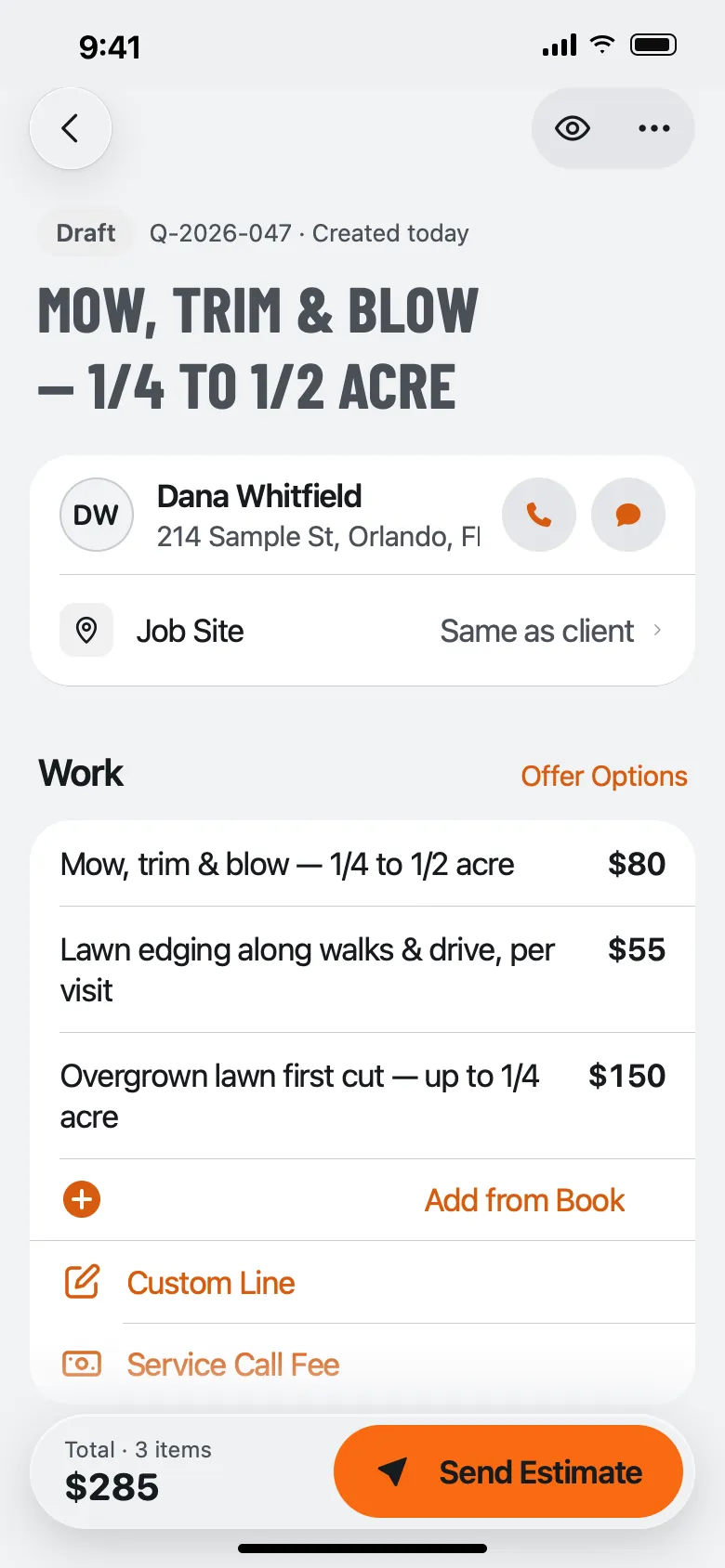
- Set your real labor rate, supplies markup and rounding once, so every price in the book becomes yours.
- Open the Mowing & Recurring Service category of the lawn and landscaping price book and pick the line that matches the lot size.
- Add the lines that apply: edging, bed weeding, or the overgrown first cut for the first visit.
- Send the quote with the monthly total shown beside the per-visit price. Customers compare monthly numbers; you price by the visit.
If you are setting a rate for the first time, start with how to price jobs as a new solo tradesman. If you want the whole structure behind these numbers, read how to build a flat-rate price book.
Mowing is one category of the lawn book; for cleanups, mulch, aeration, sod and irrigation lines at the same three rates, see the lawn care pricing chart.
Prices checked October 13, 2026 against QuoteIron’s price book (priced 2026-09). Wage figures from the Bureau of Labor Statistics page linked above, read October 14, 2026. Hours and supplies are typical starting points; your equipment, your lots and your market decide the real number. Not legal, tax or licensing advice.