By QuoteIron TeamUpdated 10 min read
Key takeaways
- The book’s three sample electrical rates are $75, $95 (the default) and $125 an hour. They are sample rates, not a market survey.
- Build your own: (take-home + overhead) ÷ billable hours. Illustration: ($75,000 + $20,000) ÷ 1,000 hours = $95 an hour.
- BLS lists a $30.38 median hourly wage for electricians nationally ($27.52 in Florida). That is an employee wage, not a billing rate.
- The rate moves small jobs very little: a first-hour call is $85, $105 or $135, and a ceiling fan with a new brace box is $430, $480 or $555.
- Give after-hours work its own line: $245 at $95/hour, $140 more than the $105 first-hour call.
Related: How much should a handyman charge per hour · How much to charge for lawn cutting · How to price an electrical panel upgrade · electrician flat-rate price book · QuoteIron help
This guide is for the electrician setting the rate, not the customer reading one. It does three things: shows how to build an hourly rate from your own numbers, shows what that rate becomes on real jobs from QuoteIron’s price book (priced September 2026), and covers how a solo electrician should handle hourly versus flat pricing, after-hours calls and the “your rate is high” objection. Every dollar figure in the job tables is the book’s formula at a stated sample rate: hours × rate, plus parts at cost with a 30% markup, rounded up to the next $5.
Which sample rate fits which kind of shop is our reading of the three numbers, not a survey of what electricians charge:
| Sample rate | Who it tends to fit (our reading) |
|---|---|
| $75/hr | New solo electrician: lower overhead, still building a customer base |
| $95/hr (book default) | Established solo electrician with a full week of repeat work |
| $125/hr | Licensed shop with a helper, a second vehicle and real overhead to carry |
Build your hourly rate from your own numbers
An hourly rate is not a number you look up. It is what you must bill for each hour you actually sell so the year pays you, pays the business and leaves a margin. The formula is: (what you need to take home + what the business costs to run) ÷ the hours you can realistically bill.
Here is an illustration, with assumptions stated, not a recommendation. Suppose an established solo electrician wants a $75,000 take-home target. Annual overhead comes to $20,000: vehicle and fuel $9,000, liability insurance and license costs $5,500, tools, test equipment and PPE $2,500, and phone, software and permit paperwork $3,000. That is $95,000 to cover. If the electrician can realistically bill 1,000 hours a year (the rest goes to driving, quoting, supply-house runs, callbacks and paperwork), the rate is $95,000 ÷ 1,000 = $95 an hour, which happens to be the book’s default sample rate.
Change one assumption and the answer moves. A new solo electrician with a $55,000 take-home target, $14,000 of overhead and 920 billable hours gets ($55,000 + $14,000) ÷ 920 = $75 an hour, the book’s starting-point rate. The number most people get wrong is the billable hours: a 2,000-hour year does not produce 2,000 billable hours. For the same method with a different set of assumptions, see how to build a flat-rate price book, and for a first-year version see pricing jobs as a new solo tradesman.
Parts are separate. Your hourly rate prices your time; the 30% markup on materials prices the supply-house run, the warranty risk and the money tied up in stock. Keep labor hours and materials cost as two different numbers on every job, the way the book does.
What the government says electricians earn, and why it is not your rate
The U.S. Bureau of Labor Statistics publishes wages, not billing rates. In its May 2025 Occupational Employment and Wage Statistics (OEWS) data, read October 14, 2026, the median hourly wage for electricians (SOC 47-2111) is $30.38 nationally, matching the BLS Occupational Outlook Handbook page for electricians, and $27.52 in Florida (series OEUS120000000000047211108 from the BLS OEWS program, retrieved through the BLS public data API the same day).
Those are what employers pay an employee for an hour of work. They do not include the employer’s payroll taxes, insurance, vehicle, tools, license, supplies, idle time or profit, which is exactly the list your rate has to cover. That is why a solo electrician’s billing rate sits well above the wage figure, and why quoting a customer your “hourly wage” undersells the business. Use the BLS figure as a sanity check on your take-home target, never as the rate.
What your rate turns into on real jobs
Here are six electrical jobs from the book at all three sample rates. Hours and parts are the book’s typical starting points; the price is hours × rate plus parts × 1.30, rounded up to $5.
| Job | Hours / parts | At $75/hr | At $95/hr | At $125/hr |
|---|---|---|---|---|
| Service call and diagnostic, first hour | 1h / $5 | $85 | $105 | $135 |
| Troubleshoot dead outlets or tripping breaker | 1.5h / $10 | $130 | $160 | $205 |
| Additional labor hour, same visit | 1h / $0 | $75 | $95 | $125 |
| Install customer-supplied light fixture, labor only | 1h / $10 | $90 | $110 | $140 |
| Install ceiling fan with new brace box | 2.5h / $185 | $430 | $480 | $555 |
| After-hours or weekend emergency service call | 2.5h / $5 | $195 | $245 | $320 |
Look at how little a rate change moves a small job. The first-hour service call is $85, $105 or $135, a spread of $50 between the lowest and highest sample rate. The additional labor hour is just the rate itself: $75, $95 or $125. On the ceiling fan with a new brace box, 2.5 hours of labor plus $185 of parts, the whole gap from $430 to $555 is $125. A customer comparing two electricians’ hourly rates is usually comparing $50 on one hour.
Parts change the picture. The customer-supplied fixture job is one hour plus $10 of parts, so it prices a little above the rate itself ($90, $110, $140) because of the parts line and the round-up to the next $5. The ceiling fan is $185 of parts, so its price depends less on your rate than a pure labor job does. Whichever mix you carry, the rate matters most on jobs that are mostly your time.
Hourly or flat rate for a solo electrician
Hourly billing is simple to explain, but it asks the customer to trust that your hours are fair, and it caps you at the speed you work. A flat-rate price book prices each repeatable job once, from your rate, hours and markup, so the customer hears a single number before you start and you keep the gain when you get faster.
- Use flat rates for repeatable work: devices, fixtures, fans, breakers, panel and service jobs, EV circuits. The book above is exactly that.
- Use the hourly line for open-ended work that grows once the wall is open. In the book that is the “additional labor hour, same visit” line at your rate ($95 at the default).
- Use a diagnostic first when the problem is unknown: the first-hour service call prices your time to find it, with repairs quoted separately.
A rate is not a price: the customer is buying the job, not your hour. For how to set up a whole book this way, read how to build a flat-rate price book, and see QuoteIron’s ready-built electrician flat-rate price book. For a big job priced the same way, how to price an electrical panel upgrade walks through it.
After-hours calls, minimums and the first hour
You do not need a separate rule for these. In the book they are ordinary lines, so the price is visible and the customer can see why.
- First hour and minimum. The service call and diagnostic is a one-hour line with meter testing and clear findings, with repairs quoted on top. At $95 it is $105. That line is your minimum for showing up.
- Troubleshooting. A dead circuit or a tripping breaker is 1.5 hours in the book: $130, $160 or $205 at the three rates.
- After hours. Nights, weekends and holidays are their own line: 2.5 hours, arrive, make it safe and diagnose, repairs quoted on top. It is $195, $245 or $320. At the default rate that is $140 more than the $105 weekday first-hour call.
Putting after-hours on its own line, rather than quietly raising your rate, keeps the weekday rate clean and makes the premium something the customer chose when they called.
“A rate is not a price: the customer is buying the job, not your hour.”
Florida note
- Sales tax on materials. The Florida Department of Revenue’s publication GT-800067, Sales and Use Tax on Construction, Improvements, Installations and Repairs (R.09/14, read October 14, 2026) says that under lump sum, cost plus, fixed fee, guaranteed price or time-and-materials real property contracts the contractor is the final consumer of materials and supplies, must pay sales tax to suppliers, and should not charge tax to the customer. In practice the tax you paid on a breaker or a fixture is a cost inside your parts line. Confirm your own situation with the Department or your accountant.
- Permits and inspections. The book carries an electrical permit and inspection line (1.5 hours; the fee is passed through at cost and varies by city). List it separately on the quote so the customer sees it is not padding, and check your own city or county for what your job needs.
Sourced facts above: BLS OEWS May 2025 and the Florida Department of Revenue GT-800067, both read October 14, 2026. General information, not tax or legal advice.
Offer three options: Good, Better, Best
On a tripping-breaker or dead-circuit call, a customer will usually choose from a clear menu faster than they approve a single number. Build the three options from lines already in the book, at the $95 sample rate:
| Option | What is in it | Price at $95/hr |
|---|---|---|
| Good | Troubleshoot the dead outlets or tripping breaker | $160 |
| Better | The troubleshooting ($160) plus a panel safety check to tighten connections and label circuits ($160) | $320 |
| Best | The troubleshooting ($160) plus a whole-home electrical safety inspection ($200) and a whole-home surge protector ($315) | $675 |
Each option is the sum of lines that are already priced in the book and rounded up to $5, so the totals are simply the lines added together.
When the customer says your hourly rate is high
- “Your hourly rate is high.” Move the conversation from the rate to the job. On a one-hour job the spread between the book’s lowest and highest sample rate is $50; on the 2.5-hour fan job it is $125.
- “The other electrician quoted less per hour.” Ask what the quote includes: the meter-tested diagnosis, the permit line, the return trip. A lower hourly number with extra lines is not a lower price.
- “Can you knock something off?” Offer the Good option rather than discounting your rate. Cutting the rate cuts your pay on every job that follows.
- “Why a service-call charge?” Because the first hour pays for the drive, the meter and the diagnosis, whether or not the repair goes ahead. It is a priced line, not a surprise.
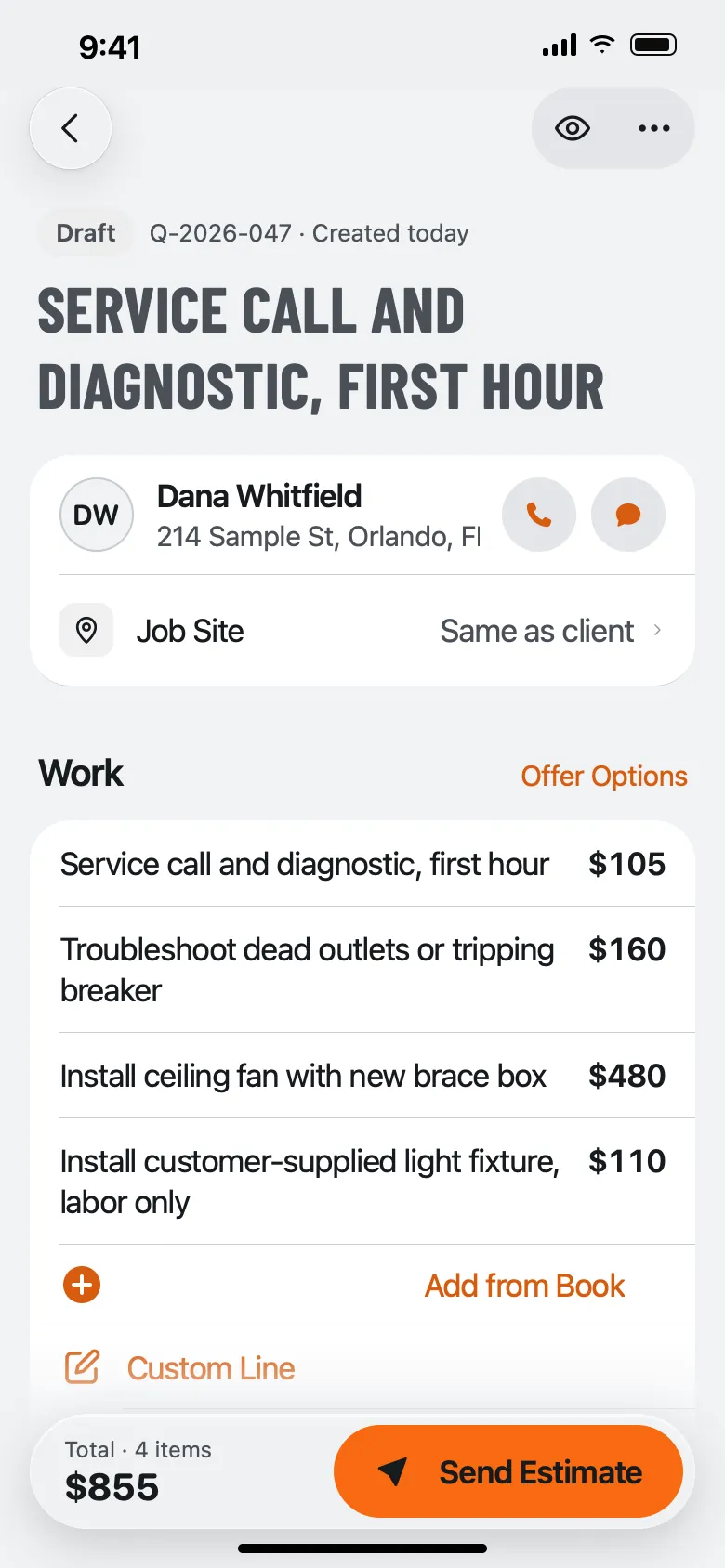
How to put your rate into a quote in about two minutes
- Work out your real rate with the formula above, then set it once, along with your parts markup and rounding.
- Open the electrical book and pick the job: service call, troubleshoot, fan, fixture, breaker or panel.
- Add the lines that apply: additional labor hour, permit and inspection, after-hours.
- Send the quote. Change the rate later and the whole book reprices.
Prices checked October 13, 2026 against QuoteIron’s price book (priced 2026-09). The three hourly rates are sample rates, not a survey of what electricians charge; your market, license, supplier and costs decide the real number. Not legal, tax or licensing advice.