By QuoteIron TeamUpdated 10 min read
Key takeaways
- QuoteIron’s price book uses three sample hourly rates, $75, $95 and $125, with $95 as the default. They are sample rates, not a market survey.
- Build your own: ($65,000 pay + $20,000 overhead) plus a 10% profit load is $93,500; ÷ 1,000 billable hours is $93.50/hour. At 800 billable hours it is $116.88; at 1,200 it is $77.92 (illustration).
- The BLS median pay for general maintenance and repair workers is $23.84/hour (May 2025). That is a wage, not a billing rate.
- Use a job minimum: the book’s first-hour service call is $85, $105 or $135. At $95, a half-day block is $400 and a full-day block is $795.
- In Florida, small-job work under $2,500 total (labor, materials and all other items) may fall in a statutory exemption, with limits on splitting jobs.
Related: How much should an electrician charge per hour · How much to charge for lawn cutting · Pricing jobs as a new solo tradesman · handyman flat-rate price book · QuoteIron help
If you are setting your own handyman rate, the useful question is not what other people charge. It is what your business needs per billable hour, and how to turn that into a job minimum, a half-day block and a flat price for the jobs you repeat. Every dollar figure here that is not labeled an illustration comes from QuoteIron’s price book (priced September 2026): hours times your rate, plus materials with a 30% markup, rounded up to the next $5. Swap in your own rate before you quote anyone.
The three sample rates and who each fits
The book carries the same handyman lines at three rates so you can see how a rate change moves every price. Read them as three starting points:
| Sample rate | Reads as | First-hour minimum | Full-day block |
|---|---|---|---|
| $75/hr | Lean start: light overhead, building reviews | $85 | $635 |
| $95/hr (default) | Working solo handyman, insured truck, steady calls | $105 | $795 |
| $125/hr | Full calendar, specialty work or high costs | $135 | $1,035 |
The “reads as” column is our judgment about how to use the samples, not market data. A price that works in one town can lose money in another, which is why the next section builds the number from your costs.
Build your rate from your own numbers
Here is the arithmetic, as an illustration only. Assume a handyman wants $65,000 a year in pay before self-employment tax, carries $20,000 a year of overhead (insurance, truck, tools, phone and software), wants a 10% profit load on top, and can realistically bill 1,000 hours a year. Pay plus overhead is $85,000. Ten percent profit adds $8,500, for $93,500. Divided by 1,000 billable hours, that is $93.50 an hour, which is why the book’s sample default is $95.
The line that moves the answer is billable hours, because estimating, driving, buying parts and invoicing are not billable. Same costs, different billable hours:
| Billable hours a year | Needed total | Rate per billable hour |
|---|---|---|
| 800 | $93,500 | $116.88 |
| 1,000 | $93,500 | $93.50 |
| 1,200 | $93,500 | $77.92 |
These are illustrative assumptions, not benchmarks. Swap in your own pay target, overhead and hours. If you are brand new, how to set your rates as a new solo tradesman walks the same math from scratch.
What the government says about the wage, and why it is not your rate
The U.S. Bureau of Labor Statistics page for general maintenance and repair workers (read October 14, 2026) lists a median pay of $23.84 per hour, or $49,590 per year, for May 2025. That is what an employee in the occupation is paid. It is a wage, not a billing rate. It leaves out your self-employment tax, insurance, truck, tools, unpaid driving and estimating time, and the hours between jobs. In the illustration above, $93.50 an hour is about 3.9 times that wage. The gap is overhead, profit and the hours you cannot bill. We could not retrieve a Florida-specific wage figure from BLS, so we leave it out.
The handyman book: trip and labor lines
These five lines in the handyman book turn your rate into a job minimum, extra hours and time blocks. Hours and materials are the book’s typical starting points; prices are at the three sample rates.
| Line | Hours / materials | At $75/hr | At $95/hr | At $125/hr |
|---|---|---|---|---|
| Service call, first hour (job minimum) | 1h / $5 | $85 | $105 | $135 |
| Additional hour of handyman labor | 1h / $0 | $75 | $95 | $125 |
| Half-day labor block, four hours | 4h / $15 | $320 | $400 | $520 |
| Full-day labor block, eight hours on site | 8h / $25 | $635 | $795 | $1,035 |
| Haul-away and dump run, pickup load | 1.5h / $75 | $210 | $240 | $285 |
Two things to notice. The first hour ($105 at $95) is more than the additional hour ($95) because it carries $5 of materials with markup and is priced as your job minimum. And the blocks sit slightly above plain hours times rate: four additional hours at $95 is $380, and the half-day block is $400 because it carries a $15 materials allowance with markup; eight hours is $760 against a $795 full-day block.
Why a job minimum beats a bare hourly number
Say a door sticks. The book prices “fix a door that sticks or won’t latch” at one hour and $8 of materials: $90, $110 or $140 at the three rates. Billed as a bare hourly rate for 20 minutes, the same visit at $95 comes to about $32, and you drove there, parked, found the problem and wrote it up. A job minimum fixes that in one move: the customer hears one price that covers showing up, and you stop losing money on the shortest jobs, which are most of a handyman’s calendar. Set the minimum as one hour of your rate plus a small materials allowance, as the book’s service-call line does, and state it before you arrive.
“you stop losing money on the shortest jobs, which are most of a handyman’s calendar.”
A few typical handyman jobs at the three rates
Here are common jobs priced from the same formula, so you can see how your rate flows into a flat price:
| Line | Hours / materials | At $75/hr | At $95/hr | At $125/hr |
|---|---|---|---|---|
| Fix a door that sticks or won't latch | 1h / $8 | $90 | $110 | $140 |
| Replace light fixture or vanity light | 1h / $15 | $95 | $115 | $145 |
| Hang floating shelves, up to three | 1.5h / $15 | $135 | $165 | $210 |
| Mount TV on drywall, into studs | 1.5h / $45 | $175 | $205 | $250 |
| Replace kitchen faucet | 1.75h / $40 | $185 | $220 | $275 |
| Replace toilet | 2h / $195 | $405 | $445 | $505 |
The TV mount ($205 at $95) is 1.5 hours of labor plus $45 of materials, with the markup applied to the materials only. The floating shelves are $165 for 1.5 hours and $15 of materials; going from $75 to $125 an hour moves them from $135 to $210. See the full handyman flat-rate price book for all 89 lines.
Hourly or flat rate per job
Hourly pricing is honest for open-ended work you cannot scope: a day of odd jobs, or a repair where you do not yet know what is behind the wall. Flat-rate pricing fits the jobs you have done many times. Quoted hourly, the TV mount is “$95 an hour plus parts” and the customer watches the clock. Quoted flat, it is $205, you keep the upside when you finish early, and the customer can say yes without doing arithmetic. Use the blocks above for punch lists and the flat price for repeat jobs. How to build the book is in how to build a flat-rate price book.
Mind the other direction too: a flat price built from typical hours loses money on a house that is not typical. Add a line, or move to hourly, when the scope is unclear.
When to raise your rate
Raise it when you are booked out for weeks, when your overhead rises, or when you find your billable hours are lower than you assumed. Because the book prices every line from one rate, changing the number reprices everything at once, so you do not edit jobs one at a time. New customers get the new number, and existing customers can be told the date it changes.
Florida note: small jobs and the license line
Florida has no state handyman license, but contracting is regulated. The exemption in Florida Statute 489.103(9) (2025 statutes, read October 14, 2026) covers casual, minor or inconsequential work where the aggregate contract price for labor, materials and all other items is under $2,500. It does not apply when the work is part of a larger operation, when a bigger job is divided into contracts under $2,500 to avoid licensing, or to a person who advertises as a contractor. For pricing, that means the total of your labor and materials on one job is the number to watch. Check the statute, the Department of Business and Professional Regulation and your city or county before you take a job near the limit. This is general information, not legal advice.
Offer three options: Good, Better, Best
A customer who calls with a list of small jobs will usually say yes to a clear choice faster than to an open-ended hourly number. Build the three options from Trip & Labor lines in the book, at the $95 sample rate:
| Option | What is in it | Price at $95/hr |
|---|---|---|
| Good | First-hour service call: one task, job minimum | $105 |
| Better | Half-day labor block, four hours of punch-list items | $400 |
| Best | Full-day block, eight hours, plus a haul-away and dump run ($795 + $240) | $1,035 |
The Best price is the full-day block ($795) plus the haul-away line ($240). Each line is priced separately in the book and rounded up to $5, so adding them gives the total shown.
When the customer pushes back on the price
- “Your hourly rate is higher than the other guy’s.” Move the conversation off the clock. Quote the job as a flat price and offer the Good option instead of discounting your rate.
- “It is just a quick fix.” The job minimum covers showing up: $105 at $95 an hour is one hour of your rate plus a small materials allowance, and it is stated before you arrive.
- “Why charge for hauling the old stuff away?” It is its own line: 1.5 hours and $75 of materials, $240 at $95. Listing it separately shows it is not padding.
- “I will buy the parts myself.” Price the labor, and say that you do not warranty parts you did not supply. The markup on your own parts pays for the supply-house run, so do not drop it on parts you buy.
- “I will think about it.” Leave the three-option quote in writing so the next call starts from your number.
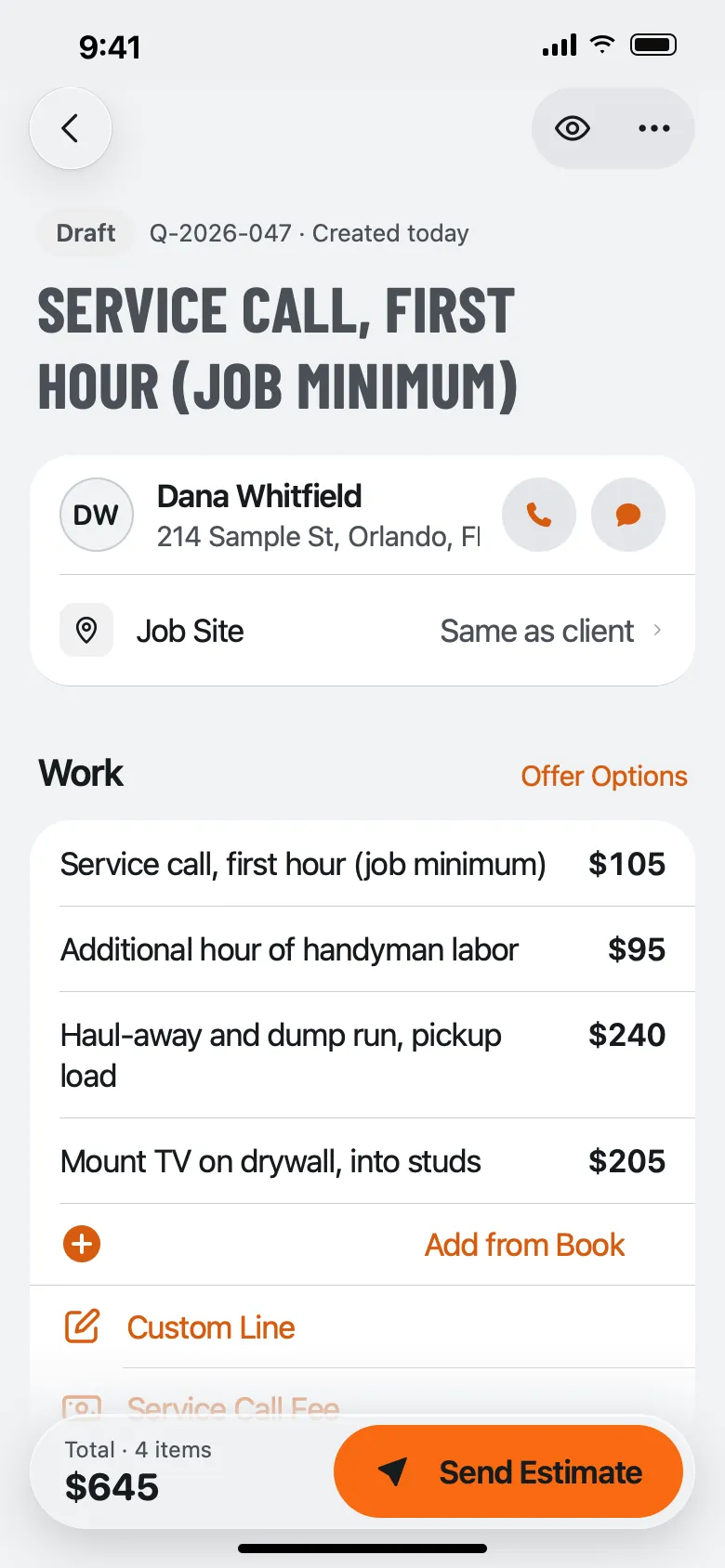
How to quote it in about two minutes
- Set your real labor rate, materials markup and rounding once. This is the step that makes every number above yours.
- Open the Handyman book and pick the job that matches, or the Trip & Labor line if the work is open-ended.
- Add the haul-away line if you are carrying debris out, and the half-day or full-day block for a punch list.
- Send the quote with the minimum stated, so the customer sees one clear price.
Prices checked October 13, 2026 against QuoteIron’s price book (priced 2026-09). Sourced facts above: U.S. Bureau of Labor Statistics, Occupational Outlook Handbook (read October 14, 2026) and Florida Statute 489.103 (read October 14, 2026). The rate build-up is an illustration with stated assumptions. Not legal, tax or licensing advice.